LDA for Multinomial likelihood
We have already looked at modeling one group of data points that are drawn from a mixture Multinomial distribution in BMM for Multinomial likelihood. Now we aim to look at the modeling J groups of data where each group is drawn from a mixture of Multinomial distributions while it is desired for these groups to share their mixture components.
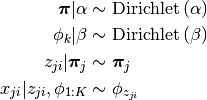
Here we assume:
- the probability vector of the Multinomial distribution is drawn from a Dirichlet distribution
Since usually MultinomialDirichlet conjugate is used in the context of text processing, we also adopt the same jargon. In this context, each mixing component is called a topic as it is a multinomial distribution over a vocabulary. There is a subtle difference in how a sample is drawn from these sentences in different papers. Some works assume that each word in a sentence is drawn from a different topic and draw one word at a time from a topic. Some other assume each sentence is drawn from one topic, and draw a sentence (i.e. n words) at a time from a topic.
Both methods are implemented in BIAS package and the relevant examples are given in the following sections.
Problem
We have  groups of data points. Each group is generated by a mixture of
  topics. Assuming
 J groups share the topics, infer them from the data.
Model
Simulated data
First we need to specify the parameters of some “true” topics. Below, we create 10 topics over 25 words.
using BIAS
srand(123)

true_KK = 10
vocab_size = 25

true_topics = BIAS.gen_bars(true_KK, vocab_size, 0)
visualize_bartopics(true_topics)

true topics
Scenario 1: MultinomialDirichelt with single observations
Now we are ready to simulate the corpus. In this section, we assume the observations are single words. We construct a corpus of 100 documents (groups), each document consisting of 50 words (observations).
n_groups = 100
n_group_j = 50 * ones(Int, n_groups)
max_n_topic_doc = 4
n_groups = 100

xx = Array(Vector{Int}, n_groups)
true_zz = Array(Vector{Int}, n_groups)
true_nn = zeros(Int, n_groups, true_KK)
n_topic_doc_p = cumsum(fill(1/max_n_topic_doc, max_n_topic_doc))

for jj = 1:n_groups
  n_topic_doc = sum(rand() .< n_topic_doc_p)
  topic_doc = randperm(true_KK)[1:n_topic_doc]

  xx[jj] = zeros(Int, n_group_j[jj])
  true_zz[jj] = ones(Int, n_group_j[jj])
  for ii = 1:n_group_j[jj]
    kk = topic_doc[rand(1:n_topic_doc)]
    true_zz[jj][ii] = kk
    xx[jj][ii] = BIAS.sample(true_topics[kk, :][:])
    true_nn[jj, kk] += 1
  end
end
Model construction
The prior-likelihood pair of this model can be seen as a MultinomialDirichlet component.
dd = vocab_size
aa = 0.1 * dd
q0 = MultinomialDirichlet(dd, aa)
Now we construct and instantiate the model:
lda_KK = true_KK
lda_aa = 0.1
lda = LDA(q0, lda_KK, lda_aa)

zz = Array(Vector{Int}, n_groups)
for jj = 1:n_groups
    zz[jj] = ones(Int, n_group_j[jj])
end
init_zz!(lda, zz)
Inference
Now it is time to run the inference routine:
n_burnins   = 100
n_lags      = 2
n_samples   = 400
store_every = 100
filename    = "demo_LDA_Multinomial_Dirichlet"

collapsed_gibbs_sampler!(lda, xx, zz, n_burnins, n_lags, n_samples, store_every, filename)

# posterior distributions
posterior_components, nn = posterior(lda, xx, zz)
to obtain the posterior distributions:
inferred_topics = zeros(Float64, length(posterior_components), vocab_size)
for kk = 1:length(posterior_components)
    inferred_topics[kk, :] = mean(posterior_components[kk])
end

visualize_bartopics(inferred_topics)

inferred topics
As it is readily seen from two figures, the model has successfully inferred the topics. Also:
Scenario 2: MultinomialDirichelt with multiple observations
In this section we assume instead of drawing one word at a time form a topic, we draw a sentence i.e. n words. We construct a corpus of 25 documents (groups), each document consisting of 100 sentences, and each sentence consisting of 230 words.
n_groups = 25
n_group_j = 100 * ones(Int, n_groups)
n_tokens = 20

alpha = 0.1
xx = Array(Vector{Sent}, n_groups)
true_zz = Array(Vector{Int}, n_groups)
true_nn = zeros(Int, n_groups, true_KK)
for jj = 1:n_groups
    xx[jj] = Array(Sent, n_group_j[jj])
    true_zz[jj] = ones(Int, n_group_j[jj])
    theta = BIAS.rand_Dirichlet(fill(alpha, true_KK))
    for ii = 1:n_group_j[jj]
        kk = sample(theta)
    sentence = sample(true_topics[kk, :][:], n_tokens)
    xx[jj][ii] = BIAS.sparsify_sentence(sentence)
    true_zz[jj][ii] = kk
    true_nn[jj, kk] += 1
  end
end
Model construction
Similar to scenario 1, we construct the conjugate object.
dd = vocab_size
aa = 0.1 * dd
q0 = MultinomialDirichlet(dd, aa)
Now we construct and instantiate the model:
lda_KK = true_KK
lda_aa = 0.1
lda = LDA(q0, lda_KK, lda_aa)

zz = Array(Vector{Int}, n_groups)
for jj = 1:n_groups
    zz[jj] = ones(Int, n_group_j[jj])
end
init_zz!(lda, zz)
Inference
Now it is time to run the inference routine:
n_burnins   = 100
n_lags      = 2
n_samples   = 100
store_every = 100
filename    = "demo_LDA_Multinomial_Dirichlet"

collapsed_gibbs_sampler!(lda, xx, zz, n_burnins, n_lags, n_samples, store_every, filename)

# posterior distributions
posterior_components, nn = posterior(lda, xx, zz)
to obtain the posterior distributions:
inferred_topics = zeros(Float64, length(posterior_components), vocab_size)
for kk = 1:length(posterior_components)
    inferred_topics[kk, :] = mean(posterior_components[kk])
end

visualize_bartopics(inferred_topics)

inferred topics
As it is readily seen from two figures, the model has successfully inferred the topics. Also:
Real data
In this section we fit LDA to a corpus of nematode biology abstracts (see https://web.archive.org/web/20040328153507/http://elegans.swmed.edu/wli/cgcbib). Yee Why Teh has used this dataset to validate HDP and showed that a model with 50 to 80 topics has the least perplexity [1]. We choose to fit a model with 70 topics on this dataset. The provided data, it taken from the link above and preprocessed. It consists of 5957 abstracts and the vocabulary size is 3793. Please consider that we are using the first representation of a MultinomialDirichelt object for this example.
First we read the dataset.
f = open("datasets\\cgcbib\\cgcbib_abs_bow.txt")
lines = readlines(f)
close(f)

n_lines = length(lines)
n_groups = 5957
n_group_j = zeros(Int, n_groups)
n_vocab = 3793

lines_mat = zeros(Int, n_lines, 4)
for i = 1:n_lines
  line = split(strip(lines[i]))
  line = [parse(Int, s) for s = line]
  lines_mat[i, :] = line
end

xx = Array(Vector{Int}, n_groups)

for jj = 1:n_groups
  print("$jj ")
  mask = lines_mat[:, 1] .== jj-1
  xx_jj_mat = lines_mat[mask, :]
  xx_jj = Int[]

  for ii=1:size(xx_jj_mat, 1)
    for rr=1:xx_jj_mat[ii, 4]
      push!(xx_jj, xx_jj_mat[ii, 3]+1)
    end
  end
  xx[jj] = xx_jj
end

n_group_j = zeros(Int, n_groups)
for jj = 1:n_groups
  n_group_j[jj] = length(xx[jj])
end
The rest is similar to previous exampes.
dd = n_vocab
aa = 0.5 * n_vocab
q0 = MultinomialDirichlet(dd, aa)

# constructing the model
lda_KK = 70
lda_aa = 1.5
lda = LDA(q0, lda_KK, lda_aa)

# sampling
zz = Array(Vector{Int}, n_groups)
for jj = 1:n_groups
    zz[jj] = ones(Int, n_group_j[jj])
end

init_zz!(lda, zz)

n_burnins   = 200
n_lags      = 1
n_samples   = 300
sample_hyperparam = true
store_every = 1000
filename    = "cgc_LDA_results_"
collapsed_gibbs_sampler!(lda, xx, zz, n_burnins, n_lags, n_samples, store_every, filename)
posterior_components, nn = posterior(lda, xx, zz)
Looking at the numerical values of a topic with cardinality of 3793 is not very informative. One better way is plotting the wordcloud of the topic. A wordcloud is a graphical representation of the topic where the font size of each word is linearly related to its weight in the probability vector.
The following code will create a directory and saves the topics as csv files and wordclouds in it.
f = open("datasets\\cgcbib\\cgcbib_abs_vocab.txt")
vocab = readlines(f)
close(f)
vocab = [strip(vv) for vv in vocab]


dirname = "datasets\\cgcbib\\LDA_results"
mkdir(dirname)

for kk = 1:length(posterior_components)

    filename = join([dirname, "topic$(kk).csv"], "/")
    topic2csv(filename, vocab, posterior_components[kk].alpha)

    filename = join([dirname, "topic$(kk).png"], "/")
    topic2png(filename, vocab, posterior_components[kk].alpha)
end
One of the topics inferred from the data is shown here:
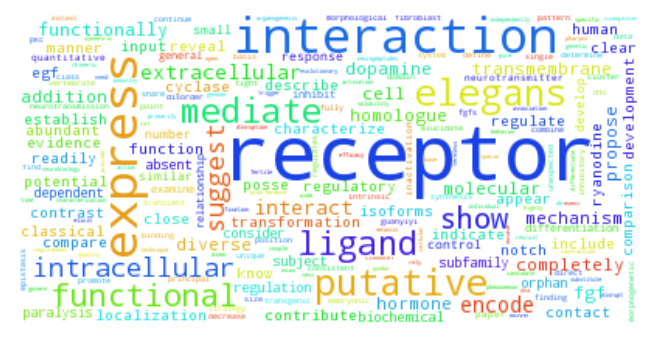
a topic inferred from cgcbib dataset using LDA